

The program for the concert by Violina Petrychenko (Ukraine) on 20.12.2025
.
"Advent Sounds"
from J. S. Bach to S. Liudkevych
In the Advent season we long for beauty, warmth
and a festive atmosphere. The concert features
piano miniatures, diverse in character and style, but at the same time
linked by a poetic, lyrical style of expression.
They create an atmosphere of expectation - of quiet
joy, peace and inner harmony.
Frédéric Chopin (1810-1849)
Mazurkas op.17
Frédéric Chopin devoted himself to the genre of the mazurka
throughout his life. Inspired by the musical heritage of his
homeland, he often spent summers in Masuria, the
region from which this folk dance originates. There he heard the
songs and melodies of local musicians and transformed
elements of the Polish folk style into an artistic
form of piano miniature.
A century later, this tradition is echoed in the
work of the Ukrainian composer Viktor Kosenko
(1896-1938). His "Ukrainian view" of the
European piano repertoire was already formed during
his studies at the Warsaw Conservatory.
Chopin's influence can be clearly felt in his early works
, including the cycle Three Mazurkas op. 3 (1916-
1923).
.
Stanislav Liudkevych (1879-1979)
Nocturne in C sharp minor (1954)
This nocturne was written in the atmosphere of cultural
salon encounters in the Lviv house of the
scientist Olha-Olena Yurkevych, where the city's
intellectual and artistic elite gathered.
She wrote in a letter to the composer:
"Sometimes I forget who you are and behave like this
informally... And sometimes I watch you -
especially when you play - and enjoy every
moment."
On December 24, Christmas Eve,
Stanislav Liudkevych responded to this special closeness with a
musical message: his Nocturne in C sharp minor.
Vasyl Barvinsky (1888-1963)
Five Preludes (1908)
Vasyl Barvinsky is considered one of the "last romantics"
in modern Ukrainian music history. His style combines
folk-song-like intonation, classical clarity
of proportions and a neo-romantic tonal language.
The Five Preludes, composed when he was twenty,
are characterized by fine nuances of colour, poetic
moods and the development of his individual
signature.
In 1948 Barvinsky was arrested and forced to burn all his own
scores in the courtyard
of the Lviv Conservatory. He spent ten years in the
Mordvin camps. After his return, he reconstructed
.
his works from memory - until the end of his life at
. He was rehabilitated in 1964.
Johann Sebastian Bach (1685-1750)
"Schafe können sicher weiden"
from the cantata BWV 208
Aria no. 9 from the cantata Was mir behagt, ist nur die
muntre Jagd, composed in 1713 for the birthday of Duke
von Sachsen-Weißenfels, has a calm, idyllic
character. The delicate melody unfolds in a baroque
pastoral sound world and sounds like a soft, light prayer.
The original aria is set for two alto recorders and basso
continuo.
Edvard Grieg (1843-1907)
Notturno, op. 54 no. 4
(from the cycle Lyric Pieces, 1891)
The cycle Lyric Pieces (1867-1901) comprises ten booklets with
miniatures, which Grieg described as the "intimate story of my
life". In these pieces he poeticized the
Nordic nature - its myths, fairy tales, tart-crystalline
beauty and quiet sublimity.
The Notturno, composed in the summer of 1891 in Trolldhaugen
, was written under the impression of the
"velvet-black nights over the bay", as Grieg wrote.
Gently pulsating accompaniment figures, song-like Nordic
melodies and colourful, sometimes impressionistic
harmonies form a sound space of quiet nocturnal depth.
.
Franz Liszt (1811-1886)
Polish from the cycle Christmas Tree, p. 186
(1873-1881)
The cycle Christmas Tree consists of twelve
character pieces and is dedicated to Liszt's granddaughter Daniela von Bülow
. The premiere took place on Christmas Eve 1881
in her hotel room in Rome.
These miniatures from Liszt's late work dispense with
virtuoso splendor; instead, they unfold a clear,
clarified tonal language and a solemn, expectant
mood of the Christmas season.
Mykola Leontovych (1877-1921)
Shchedryk
(piano transcription by Serhii Yushkevych)
Shchedryk, known worldwide as Carol of the Bells, is based
on a Ukrainian New Year melody whose roots go back
to Kievan Rus. Originally
it symbolized the beginning of spring, which for the
Eastern Slavs coincided with the return of the swallows.
Leontovych transformed this simple four-note melody into a masterful choral composition, which
achieved international fame.
In the 1920s, the Ukrainian National Choir
under Alexander Koshetz made the work famous during a
world tour. After it was heard in New York's Carnegie
Hall, the conductor Peter Wilhousky created the
English version Carol of the Bells, in which the swallows
were replaced by "jingling bells".
.
Leontovych, who was hiding from Bolshevik
repression in Ukraine, was murdered in 1921 by an agent of the
Soviet Cheka - without knowing that
his Shchedryk was to become one of the most famous musical
symbols of Ukraine.
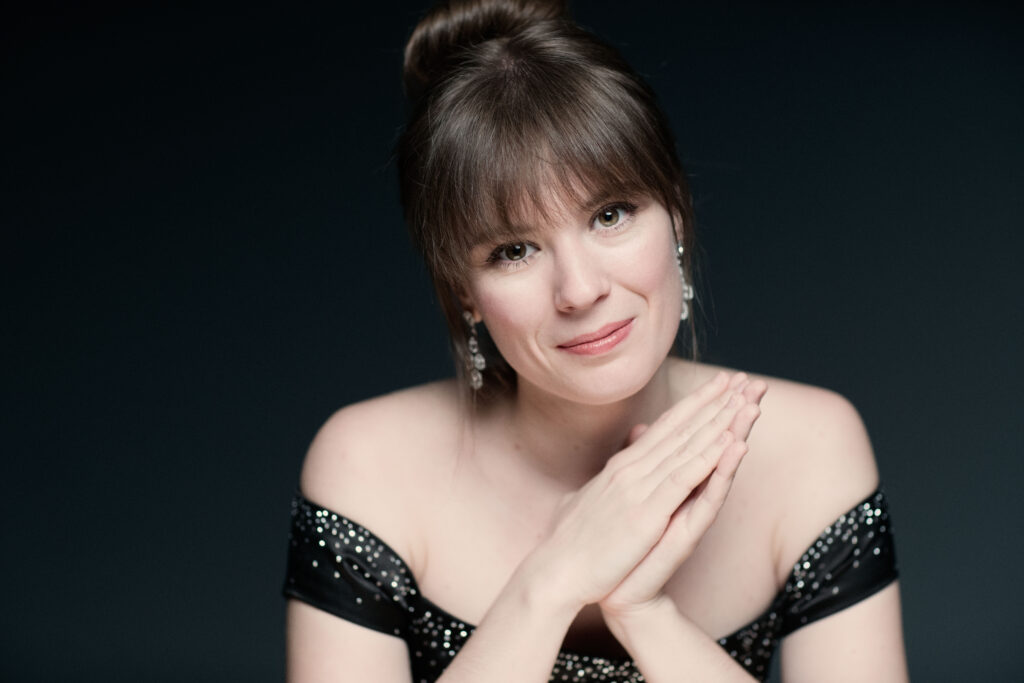
Violina Petrychenko (piano)
The Ukrainian pianist from Zaporizhzhya received her
musical education at the Ukrainian National Academy of Music
and later continued her studies at the
conservatories in Weimar, Cologne and Essen. She
was awarded the DAAD prize, among others. A
central focus of her artistic work is the
international presentation of Ukrainian piano music.
With highly acclaimed recordings such as Ukrainian
Moods, The Silent Voice of Vasyl Barvinsky and
Dreams - Ukrainian Hope (Opus Klassik nomination)
, she has established herself as an important ambassador of this music
. Her
rediscovery of the works of Vasyl Barvinsky, whose
piano concerto she performed for the first time in London and Palermo
in 2022, was particularly well received.
As a sought-after concert pianist, she performs regularly in
Germany and Europe. In 2023, she founded the festival
Sounds of Ukraine, which presents the diversity of Ukrainian music
 Her most recent projects include performances in
the Berlin Philharmonie and concert tours with
works by Barvinsky and Kosenko. Her latest album
Winter Whispers met with a great response in the European press
.

                                      Tatjana Shylina-Lenk