


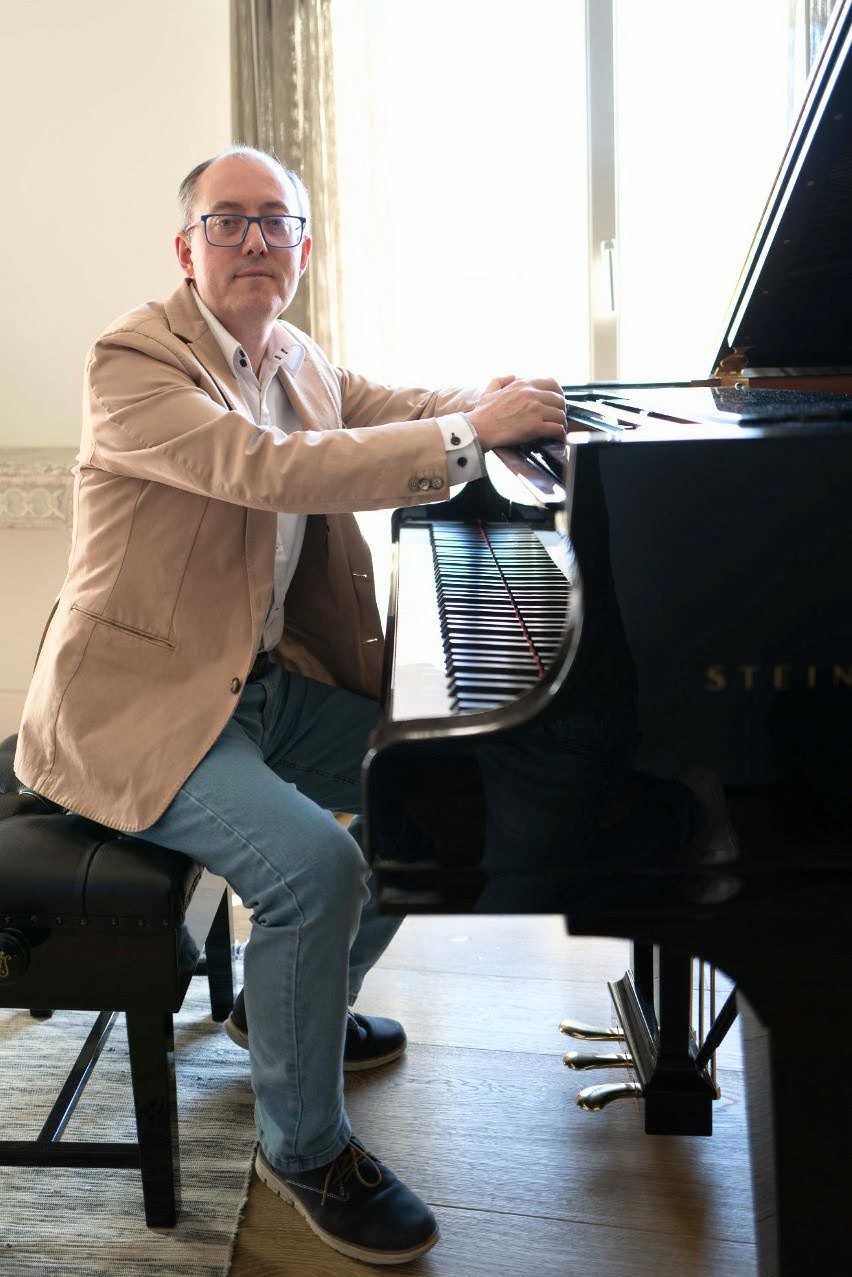
Concert program by Vadim Gladkov (Ukraine, Spain) on June 28, 2026.
Ludwig van Beethoven (1770–1827)


Piano Sonata No. 12, Op. 26, in A-flat major

Franz Liszt (1811-1886)

  Love Song
From *Harmonies poétiques et religieuses*, p. 173
  Impromptu in F-sharp Major, S. 191
  Mephisto Waltz No. 1

Levko Revutsky (1889–1977)
  Three Preludes, Op. 4, Op. 7

Hennadii Liashenko (1938–2017)
  Reflections (1992)

Mykola Lysenko (1842-1912)
  Ukrainian Rhapsody No. 2 “Dumka–
"Schumka"


Inspirations. Sensations. Reflections.


The program unfolds as a dialogue between European
and Ukrainian music.
While the works of Beethoven and Liszt laid the foundations for the
embody the European piano tradition, as demonstrated by Lysenko,
Revutsky and Liashenko, how these artistic ideas in the
Ukrainian music takes on a new form. From the
From the Romantic era to the modern era, from the roots of the folk song to
On contemporary compositional techniques, this reveals the
A concert embodies the continuity of a cultural dialogue in which
Inspiration from the Past: Feelings and Reflections
future generations.


Ludwig van Beethoven (1770–1827)
Piano Sonata No. 12, Op. 26, in A-flat major

The sonata was composed between 1800 and 1801,
around the same time that Beethoven composed his First Symphony
completed. The work is dedicated to Karl von Lichnowsky, a
A patron of the composer since 1792, and in 1802 in Vienna
published under the title “Grande Sonate.” It marks
a conceptual turning point in piano composition
Beethoven's. The composer transcends the boundaries of
classical sonata form—even the first movement does not begin with
not with a traditional sonata allegro, but with a
Variation cycle, and no movement is in sonata form
written.

Franz Liszt (1811-1886)
“Hymn to Love” from the cycle *Harmonies poétiques et*
Religieuses, p. 173 (1847–1853)

  .
The protagonist is Princess Carolyne von Sayn-Wittgenstein
dedicated to the woman the composer met in Kyiv in 1847. Her
Their close friendship lasted until the end of Liszt's life. He dedicated
as well as all of his symphonic poems.
During this period, Liszt increasingly turned away from the life of the
traveling virtuosos and focuses intensively on
philosophical and religious topics. Poetry, in particular,
Alphonse de Lamartine's Questions on Faith, Suffering, and Love
...and the theme of spiritual renewal inspired him.

“Impromptu” in F-sharp major, S. 191 (1872)
The work was composed in Weimar during the late period of his career
Liszt's, in which he increasingly turned to chamber music,
turned his attention to concise piano miniatures. It is the Baroness
Dedicated to Olga von Meyendorff, who belonged to the close circle of the
Belonged to composers.

Mephisto Waltz No. 1 (1856–1861)
The Mephisto Waltz No. 1 is a virtuosic portrayal of a
An episode from Nikolaus Lenau's poetic adaptation of *Faust*.
Faust and Mephistopheles enter a village tavern where
A wedding reception is currently taking place. Mephistopheles takes
He gets a violin from a farmer and starts playing
(as illustrated by the succession of fifths at the beginning of the
(Work). The villagers find themselves caught up in a demonic
Dance Frenzy. After the main section returns, a
Slow middle section with a new theme: Faust seduces a young
Woman, and both of them eventually disappear into the forest. The singing
A nightingale sings, and the music builds to a
A highlight that some researchers consider to be one of the first
musical depictions of an orgasm in classical
Music is interpreted: Faust spends a passionate
A night with the woman.
This scene forms the basis of one of the most powerful and
Liszt's most brilliant piano works.
  .
Levko Revutsky (1889–1977)
Three Preludes, Op. 4 (1914), Op. 7. (1918)

Levko Revutsky belongs to the generation of composers who
20th-century Ukrainian musical modernism
that shaped the 20th century.
He grew up in the Poltava and Chernihiv regions –
Regions with a deep-rooted tradition of polyphonic
Folk singing. His aesthetic ideas took shape in
an era of historic upheavals—World War I,
the 1917 Revolution and the brief period of Ukrainian
Statehood. The political turmoil of that period led to a
A shift in artistic direction and contributed to the
The emergence of a new modernist aesthetic with a
sharp, laconic, and harmoniously condensed
The Language of Music. Revutsky’s style is an organic synthesis of
Folk Music and European Modernist Trends –
Post-Romanticism and Impressionism.

Hennadii Liashenko (1938–2017)
"Reflections" (1992)

Hennadii Liashenko is one of the leading representatives of the
Ukrainian school of composers of the second half of the 20th century
of the 19th century. As the composer of seven symphonies and a ballet
as well as numerous chamber music and vocal works
he developed a distinctive style characterized by formal clarity,
polyphonic thinking, sound dramaturgy, and a
combines chromatically dense harmonies.
His style emerged at the intersection of Ukrainian
musical tradition and new European
Compositional techniques in the multicultural environment of Lviv.
The composer himself remarked:
"In my works, the influence of Carpathian intonation
noticeable. In addition, a multinational
  .
musical context that includes Austrian, Polish,
Czech and national trends coexisted—with a
Word: “a European school.”
The piano piece *Spiegelungen* was selected in 1992 as the required piece for
composed for the International Mykola Lysenko Competition.
In its concentrated form, it combines characteristic
Characteristics of Liashenko's style: an awareness of timbre,
Polyphonic development and internal logical structures of the
musical process. Varied and mirrored
Transformations of the thematic elements result in
the effect of an internal “echo” of the musical image.

Mykola Lysenko (1842-1912)
Ukrainian Rhapsody No. 2 “Dumka–Schumka”
(1877)
Mykola Lysenko ranks among the greats of Ukrainian culture
19th-century Romantic composers such as Chopin,
be compared to Liszt, Brahms, or Dvořák. As a composer,
A pianist, conductor, and ethnographer, he received a thorough
European education, including at the University of Leipzig
Conservatory, majoring in composition and piano. The
Combining European traditions with in-depth knowledge of the
Ukrainian folk culture formed the foundation of Ukrainian
A school of composers from the late 19th century, whose
Lysenko is the founder.
In the 19th century, the rhapsody genre was characteristic of
Romantic composers such as Liszt, Brahms, and Dvořák.
Lysenko carries on this tradition in Ukrainian music and
creates a large-scale, masterful work based on folklore
Background. While Liszt's Hungarian Rhapsodies
While folk music is based on recitative elements, in Lysenko's work these are the
Intonations of the Kobzars—the traditional Ukrainian
epic singer—combined with the rhythm of the
Folk dancing.

  .
Vadim Gladkov
, born in Kyiv, is one of the
one of the most outstanding pianists of his generation. His studies at the
He graduated from the National Music Academy of Ukraine in Kyiv with
He received the award and continued his studies at the Escuela
Superior de Música Reina Sofía in Madrid. His playing
impresses with its stylistic versatility and depth
musical expression combined with technical brilliance.
In addition to numerous other achievements, Vadim Gladkov won the following, among others:
Prices:
• Grand Prize at the 9th International "Da" Piano Competition
"Cidade do Porto" (1992)
• First Prize and Gold Medal at the 1st International
"N. Lyssenko" Competition (Kyiv, 1992)
• First Prize at the 12th International Piano Competition in
Ibiza (1998)
• First Prize at the 4th International
"Guadamora" Chamber Music Competition (Córdoba, 2003)
• First Prize and Special Prize at the 7th International “Grieg”
Piano Duo Competition (Oslo)
As a soloist and chamber musician, Gladkov performed at the Royal
Albert Hall, the Concertgebouw, the Rudolfinum, and at the
Suntory Hall. Invited to major festivals in and
Outside of Europe, he performed with renowned musicians such as
Zakhar Bron, Nicola Benedetti, Natalia Gutman, and Hansjörg
Schellenberger.

In addition to his active concert career, he teaches as
Professor of Piano at the Escuela Superior de Música Reina Sofía
in Madrid, and regularly gives master classes throughout
Europe.

His discography includes, among other things, recordings with
outstanding artists, including the CD “In Recital” featuring the
Violinist Mayuko Kamio (SONY BMG). Vadim Gladkov is a member of
undoubtedly one of the most respected pianists of our time.


 Tatjana Shylina-Lenk


