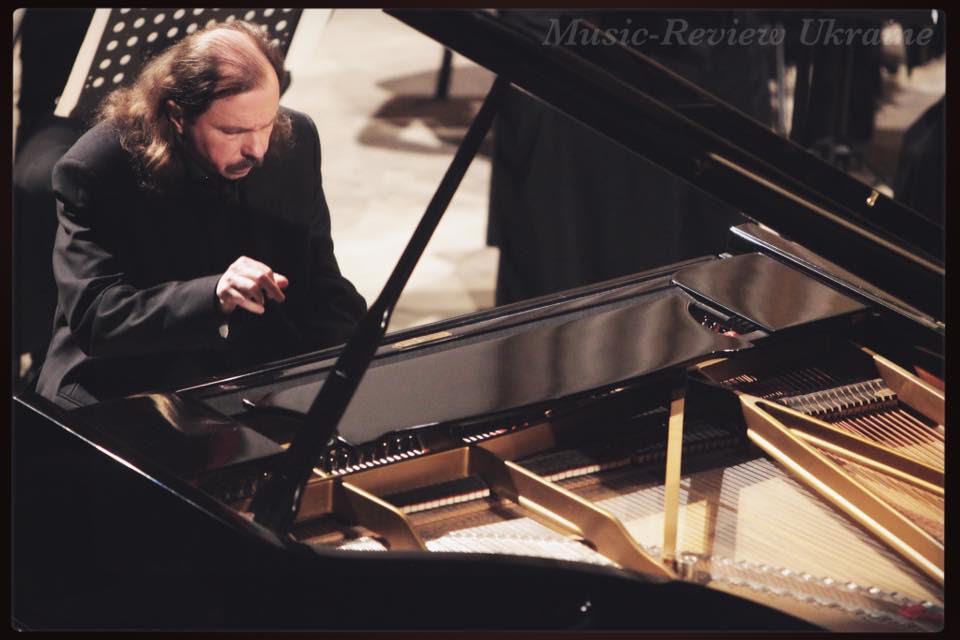


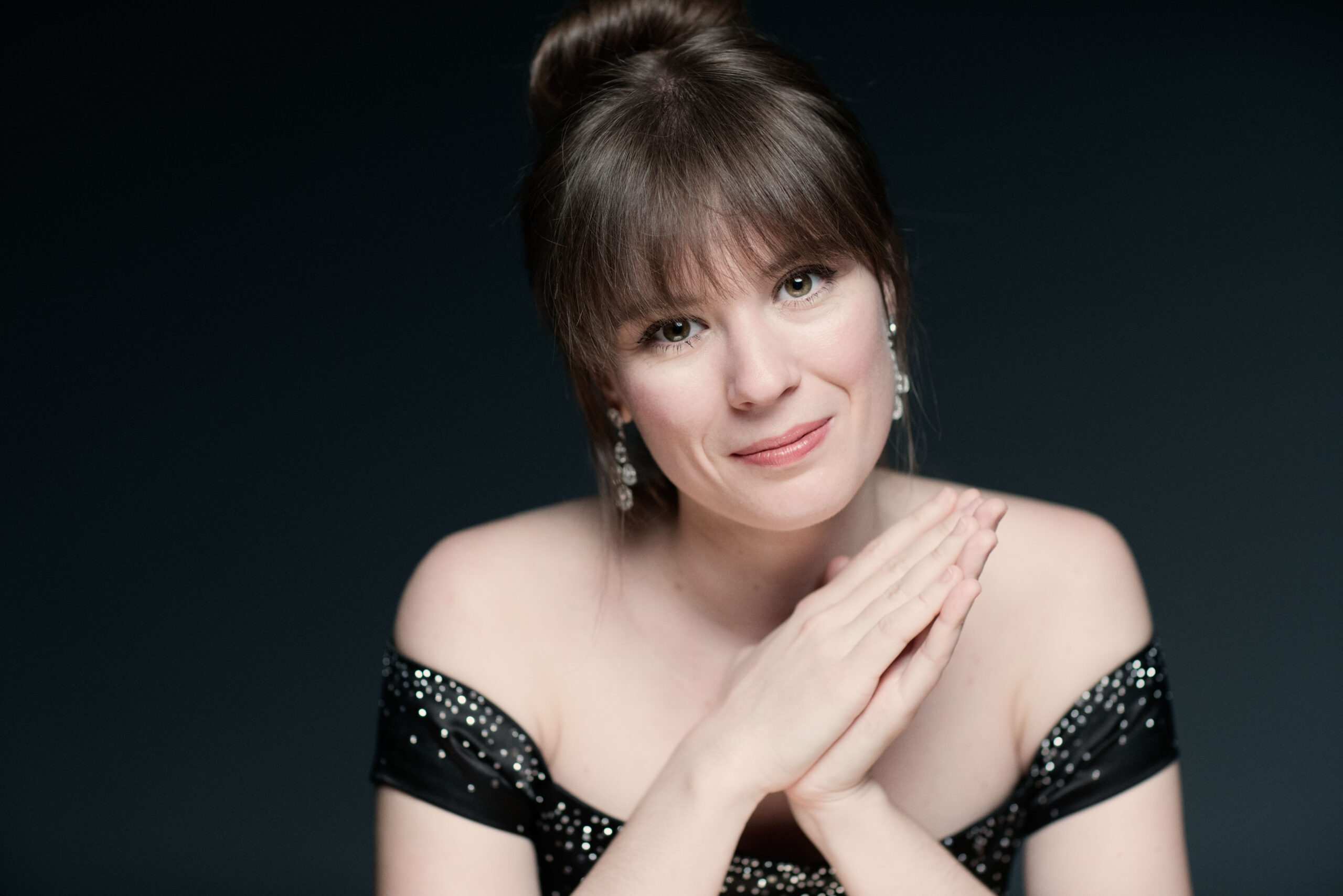
Concert program by Anna Fedorova (Ukraine, Netherlands) on April 25, 2026
.
PROGRAM
Ludwig van Beethoven (1770–1827)
Klaviersonate Nr.23, op.57 „Appassionata“
(1804-1805)
Johannes Brahms (1833–1897)
Sechs Klavierstücke op. 118 (1893)
Viktor Kosenko (1896-1938)
Zwei Poeme-Legenden op.12 (1921)
Myroslav Skoryk (1937–2020)
Walzer aus Partite No.5 (1975)
Borys Fedorov / Anna Fedorova
2 Improvisationen über Themen
französischer Chansons (2020)
.
Wien — Kyjiw: zwei Städte—vier Stimmen
In unserem heutigen Konzertprogramm Wien-Kyjiw:
zwei Städte - vier Stimmen möchten wir Sie mitnehmen auf
den Weg von Wien bis in die Ukraine.
Ludwig van Beethoven’s legendary “Apassionata”
and Johannes Brahms’s Opus 118 engage in a dialogue with
works by Ukrainian composer Viktor Kosenko and
works by Myroslav Skoryk.
If one traces the musical development of these
outstanding Ukrainian composers of the 20th century,
If you follow the traces of the 19th century, they will ultimately lead you back to Vienna.
Viktor Kosenko’s first important teacher at the Warsaw Conservatory (
) was Alexander Michalowski, a student of the Polish composer and pianist Ignaz Moscheles (
). He (
) had studied composition in Vienna under Georg Albrechtsberger and Antonio Salieri (
).
Among Myroslav Skoryk’s teachers of classical Ukrainian music
was Stanislav Ljudkevytsch, who
received his training at the Vienna Music Institute in the class of the
Austrian composer Alexander von Zemlinsky
and Herrmann Graedner.
The powerful roots of the “Vienna School,” dating back
more than 200 years, continued to influence other cultures
through its successors—including Ukrainian culture—where they
fell on fertile ground and bore unique,
distinctive fruit.
Ludwig van Beethoven (1770–1827)
Sonata No. 23 in F minor, "Appassionata," Op. 57
(1804–1805)
Ludwig van Beethoven's "voice" in early 19th-century Vienna
became a symbol of an era
.
and at the same time a harbinger of a new way of thinking that opened up new perspectives for composers following in the footsteps of the “
.”
Beethoven's Enthusiasm for the French
The revolution, which he initially associated with Napoleon, gave way to
disappointment following Napoleon’s coronation as emperor: Beethoven
withdrew the dedication of his Third Symphony (Eroica, 1804)
; rather, his later work became a
portrayal of inner conflicts and personal drama.
His progressive hearing loss increasingly threatened his ability
to perform as a pianist or conductor.
During this phase, described by musicologists as “heroic”
, the Sonata No. 23 in F-sharp minor
“Appassionata” was composed.
By experimenting with newly developed instruments
, Beethoven explores new sonic possibilities of the
piano. By enriching the instrument’s construction with new
Contrasts in timbre and dynamics, along with the
expansion of the
registers, give rise—within the classical form
—to a new quality: an expressive style that forms the
foundation of musical Romanticism.
Johannes Brahms (1833–1897)
Piano Pieces, Op. 118 (1893)
In Vienna, the city of Beethoven's legacy,
Johannes Brahms gained widespread recognition as one of the
leading figures of the European musical tradition in the
second half of the 19th century; his First Symphony
was described by critics as "Beethoven's Tenth."
Brahms drew on classical genres and
transformed them, varying them with great diversity to achieve
an inner coherence.
The piano pieces, Op. 118, completed in 1893 and dedicated to Clara
Schumann, consist of six miniatures:
.
They were composed four years before the death of the
composer. Each piece unfolds a multifaceted spectrum
of inner emotion. In the final intermezzo, an
allusion to the medieval motif of the Dies Irae
becomes audible, dissolving into the sonic beauty of
Brahms’ harmonies and connecting time and space
.
Viktor Kosenko (1896–1938)
Two Poems—Legends, Op. 12 (1921)
Viktor Kosenko’s music is set against the
backdrop of the turbulent events surrounding
the founding of the Ukrainian People’s Republic in 1918.
At the start of World War I, the
family moved to Petrograd because their father was serving in the military.
In 1918, the young composer returned to Zhytomyr.
By that time, Kosenko was already a musician who—
—had been shaped by the cultural milieu in Warsaw
.
During these years, Kosenko’s
unique musical language began to take shape—a fusion
of Western musical culture with Ukrainian intonational
thought.
For the first time, the genre of the “
” appears in Ukrainian music. In the “Two Poems-Legends,” Op. 12
unfolds through intonational development and
Factual dramaturgy is a distinct musical language—
—in which the tension of the era, internal escalation, and profound
lyricism converge—those qualities that define Kosenko’s
“voice” within the European context of the 20th century
.
.
Myroslav Skoryk (1938–2020)
Waltz from Partita No. 5 (1975)
Myroslav Skoryk’s “voice” infuses Ukrainian
musical culture with a vibrant, inexhaustible
energy that is constantly renewed, despite the tragic challenges
of the 20th century.
It is symbolic that the composer’s parents met in
Vienna, where they were both studying at the university
. Skoryk’s upbringing in an educated,
artistically inclined family, as well as his early musical
impressions at home, had a lasting impact on his path.
In his work, Skoryk combines various
stylistic levels—ranging from folkloric sources to
modern compositional techniques. His musical
language is characterized by melodic conciseness,
tonal richness, and harmonic freedom; elements of
jazz improvisation are also organically
integrated.
The “Waltz” from Partita No. 5 appears as
an ironic allusion to the 19th-
-century Viennese waltz: The characteristic triple meter
is retained, but reinterpreted through jazz-inspired harmonies
and flexible, nuanced rhythms.
Borys Fedorov / Anna Fedorova
Improvisations on themes from French
chansons (2020)
The turn toward the French chanson arose
from Anna Fedorova’s encounter with the French
actor Pierre Richard. As part of a
joint project, the pianists developed a
.
unique musical concept that captures the atmosphere
of France in the 1970s and 1980s.
Their in-depth exploration of the genre
gave rise to improvisations on themes by two
chansonniers—Barbara (“Pierre”) and Georges Moustaki
(“Ma Liberté”). The improvisations by Anna and Borys
Fedorov thus form another “voice”—free, lively
, and open—that connects tradition and the present, Vienna and Kyiv,
academic art and improvisation
.
Anna Fedorova
The Ukrainian-Dutch pianist Anna Fedorova
has captivated audiences since early childhood with her extraordinary
musical maturity and brilliant technique.
She performs regularly in leading concert halls around the world,
including the Concertgebouw in Amsterdam, Carnegie Hall
and Lincoln Center in New York, the Tonhalle in Zurich,
the Elbphilharmonie in Hamburg, and the Royal Albert Hall
in London.
She is a regular guest at major festivals, including the
, the Verbier Festival, the Ravinia Festival, and La Roque-
-d’Anthéron.
In addition to her artistic work, she has been actively involved in benefit concerts for Ukraine since
2022.
Anna Fedorova received her training in Kyiv, Imola, and
at the Royal College of Music in London. Her mentors
include Alfred Brendel and Sir András Schiff, among others. She is
a co-founder of the Davidsbündler Music Academy in The
Hague.
Tatjana Shylina-Lenk