


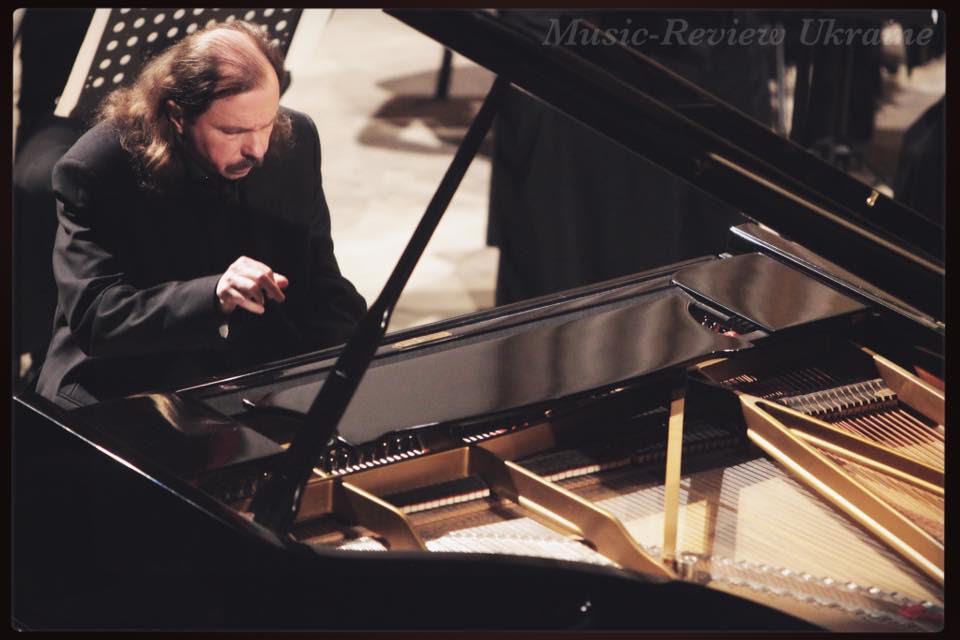
Konzertprogramm von József Örmény (Ukraine) am 20.09.2026 in der Ev.Grunewaldkirche, Berlin
Wege und Wandlungen
Mykola Lysenko (1842–1912)
Heroisches Scherzo op. 25 (1880)
Franz Schubert (1797–1828)
Moments musicaux Nr. 2 und Nr. 3, D 780,
op. 94 (1823–1828)
Yevhen Stankovych (1942)
Sonatina (1966)
Vasyl Barvinsky (1888–1963)
Zwei Präludien aus „Acht Präludien“ op. 8
(veröffentlicht 1918)
Bohdana Frolyak (1968)
Beethoven’s Cloud No. 2 (2023)
Franz Schubert (1797–1828)
Impromptu Nr. 4, As-Dur, op. 90, D 899 (1827)
Robert Schumann (1810–1856)
Sonate Nr. 1 fis-Moll op. 11 (1833–1835)
Wege und Wandlungen
Im Programm stellen wir westeuropäische und
ukrainische Komponisten vor, die nach dem Prinzip
des Kontrastes miteinander verbunden sind.
Dadurch wird deutlich, wie sehr sich Gattungen, Stile
und musikalische Sprache unter dem Einfluss
gesellschaftlicher Veränderungen und individueller
künstlerischer Intention wandeln.
Mykola Lysenko (1842–1912)
“Heroic Scherzo,” Op. 25 (1880)
During the Romantic era, the genre of the scherzo (Italian: scherzo—“joke”)
evolved in 19th-
century music into an independent concert piece with
a distinct dramatic structure, striking contrasts, and
brilliant virtuosic craftsmanship.
Mykola Lysenko’s “Heroic Scherzo” carries on the
traditions of European Romanticism, particularly the
traditions of Frédéric Chopin. The heroic gesture, the
vivid imagery, and the lyrical elevation of the music
stem from the intonations of Ukrainian dumy (epic
songs), folk songs, and Cossack dances.
It is noteworthy that Lysenko composed the “Heroic Scherzo”
while working on his opera “Taras Bulba,” based on the
story of the same name by Nikolai Gogol. Thus,
the work continues the tradition of Ukrainian
heroic history and the Cossack epic.
Franz Schubert (1797–1828)
Moments musicaux D 780, Op. 94
(1823–1828)
The Moments musicaux and the Impromptus, Op. 90
, were composed during the final years of Schubert’s life—a
period of peak creative maturity. This creative period
also includes the Unfinished Symphony, the string quartet
“Death and the Maiden,” the song cycle “Winterreise”
, and the last piano sonatas.
At the beginning of the 19th century, a
new artistic worldview emerged in Europe that focused on the personal
realm of human experience, psychological reflection, and
inner freedom. In Schubert’s music
, we encounter that unique sense of musical time,
which Robert Schumann described as “heavenly length.”
Through the lyrical flow of the melody, harmonic
freedom, and the subtle variability of the composition,
Schubert imbues the moment with artistic permanence and unfolds
its inexhaustible wealth of emotional nuances.
Yevhen Stankovych (b. 1942)
is considered one of the
most important figures in contemporary Ukrainian
music. His body of work includes symphonies, operas, ballets,
chamber and choral works, as well as film scores.
The Sonatina (1966)
was composed using twelve-tone and
serial techniques. Even as a student at the Kyiv
Conservatory, Stankovych turned to the innovative
compositional techniques of the Second Viennese School—Arnold
Schönberg, Alban Berg, and Anton Webern—as well as the early
works of Pierre Boulez. This engagement opened up
a wide field of musical experimentation for him within the realm of the
avant-garde.
Just as Cubism breaks down a painting into individual elements
, the musical architecture of the Sonatina arises from
the interplay of independent sound structures, their
division into different registers, tonal and
rhythmic contrasts, and diverse configurations of the
serial material.
Vasyl Barvinsky (1888–1963)
The Ukrainian composer, pianist, educator, conductor, and
music official Vasyl Barvinsky is considered one of the most tragic
figures in Ukrainian music history.
In 1948, Barvinsky was arrested. Following the verdict of the
Soviet authorities, he spent ten years in a
labor camp in Mordovia; most of his manuscripts
were destroyed. Upon his return, the
composer reconstructed numerous works of his own from memory.
The two preludes from the cycle *Eight Preludes, Op. 8*
were composed while Barvinsky was a student at the
Conservatory in Prague and were published in Leipzig in 1918.
Even these early works drew the attention of the European
music world to the extraordinary talent of the young
Ukrainian composer.
Even in his early compositions, Barvinsky
organically combines Ukrainian melodies with the tonal
color of European musical modernism.
His preludes are characterized by finely nuanced
timbres, subtle dynamic gradations,
impressionistic, shimmering harmonies, and a
transparent texture.
Bohdana Frolyak (*1968)
Beethoven’s Cloud No. 2
(2023) is dedicated to the memory of
the Ukrainian conductor Yurii Kerpatenko,
who was murdered in 2022 in Kherson by Russian occupying forces
.
The work was created as part of the international project
32 Bright Clouds: Beethoven Conversations Around
the World. The world premiere took place in Tokyo in 2025;
the work was subsequently performed in Ukraine and in New
York. In Berlin, Bohdana Frolyak’s composition
will be performed for the first time.
The allusions to Beethoven’s Second Piano Sonata
are woven into the suspenseful dramaturgy of the work
and take on new meaning in the context of contemporary Ukraine
. The concluding D-flat major chord
—shifted down a half-step
from Beethoven’s original—seems to symbolize a world
that has been thrown off its axis and will never again
be the same.
“Art, I believe—especially music—should leave one with a sense
of light and catharsis.”
(Bohdana Frolyak)
Franz Schubert (1797–1828)
Impromptus in A-flat major, Op. 90, No. 4
…………………………………………………………………
Robert Schumann (1810–1856)
Sonata No. 1 in F-sharp minor, Op. 11 (1833–1835)
Robert Schumann wrote to Clara
Wieck about his First Sonata, describing it as a solitary cry from his heart to her; the theme associated with Clara
appears in it in many
different forms.
Composed between 1833 and 1835, the First Sonata belongs
to the composer’s early creative period.
The first edition was dedicated to Clara Wieck and was published under
the names Florestan and Eusebius—Schumann’s two
creative alter egos, who embodied the contrasting sides
of his artistic personality. The sonata consists of four movements,
which are linked by thematic connections through “
.”
Musicologists emphasize their
an unusual compositional structure
: lyrical themes,
, which Schumann drew from his early song compositions, run
throughout the entire cycle and lend the sonata a
inner unity as well as a special psychological
coherence.
Tatjana Shylina-Lenk
József Örmény
is a People’s Artist of Ukraine, a professor
, and head of the piano department at the Mykola Lysenko
Conservatory in Lviv, as well as one of Ukraine’s most renowned
pianists and an outstanding interpreter
of works from a wide variety of musical eras.
His repertoire ranges from the Baroque and Romantic periods to
the music of the 20th and 21st centuries, with a special
focus on Ukrainian music.
In his program “Paths and Transformations,”
the pianist presents works by Franz Schubert, Robert Schumann,
Yevhen Stankovych, Bohdana Froliak, and Mykola Lysenko.


