


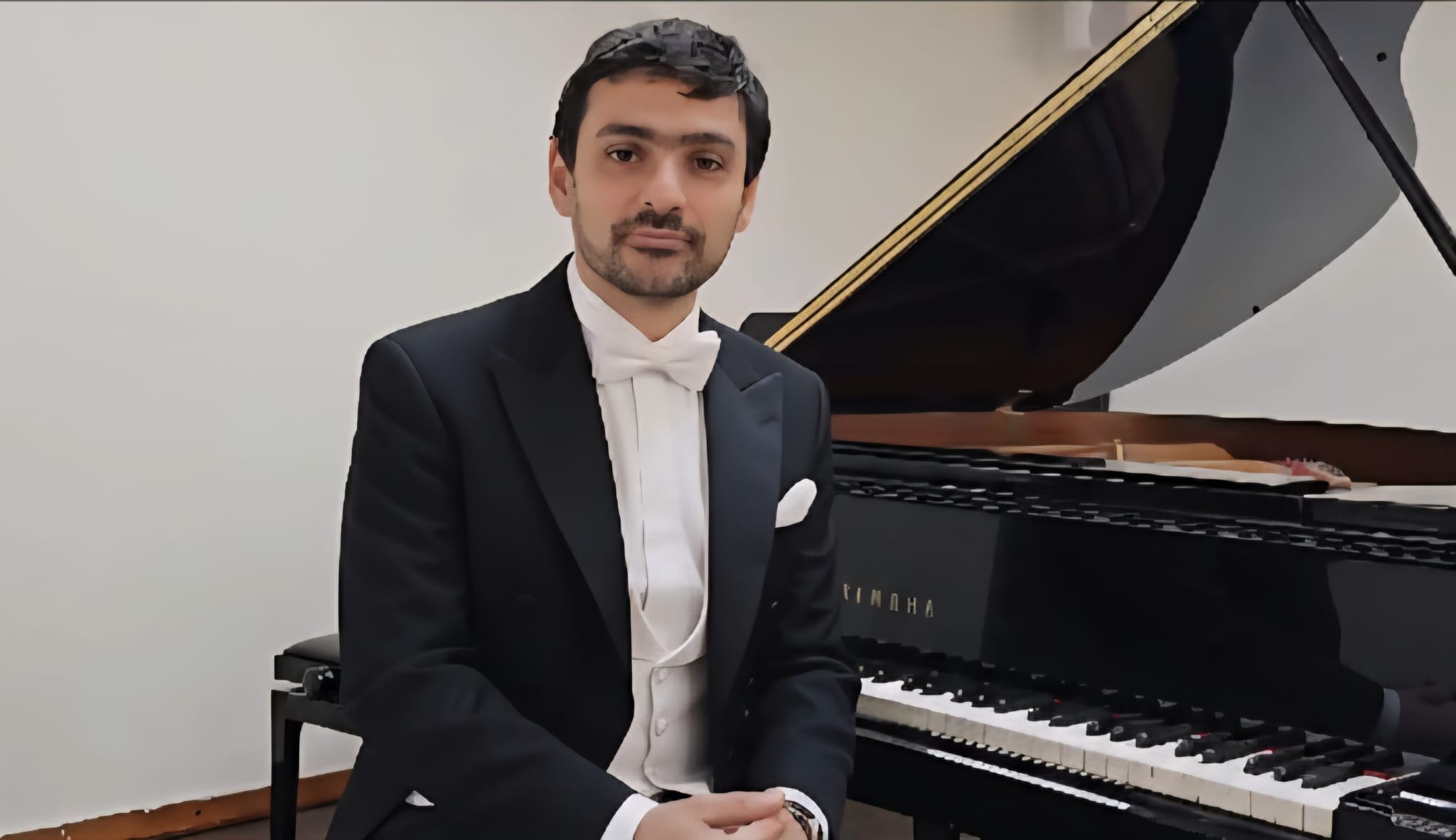
The program for the concert by Boris Zobin (Ukraine) on 24.01.2026
Frédéric Chopin (1810-1849)
Barcarolle in F sharp major, Op. 60 (1845-1846)
Franz Liszt (1811-1886)
Vallée d'Obermann
from Années de pèlerinage I: Suisse, p.160
(1848-1854)
Viktor Kosenko (1896-1938)
Études in the form of old dances, Op. 19 (1928-1929)
- Minuet
- Courante
- Sarabande
- Bourrée
- Gavotte
- Passacaglia
.
Riding the waves of Romanticism
The heyday of Romanticism in music developed
in the 19th century. The expansion of traditional
musical forms, bold harmonic
experiments, freer expressive possibilities on the
instrument and improvisational virtuosity became
characteristic of the composers' works. This
style, closely associated with salon culture, enabled
a lively, flexible and spontaneous way of playing and
opened up new horizons of emotional expression.
The concert program includes works by three
composers: Frédéric Chopin (1810-1849), Franz
Liszt (1811-1886) and Viktor Kosenko (1896-1938).
Despite belonging to different eras
, these artists share some essential
similarities. All three were brilliant pianists,
and the piano became the main instrument of their
musical expression. Each of them mastered
the art of improvisation with virtuosity: Chopin and Liszt
delighted audiences in salons and on
concert stages, while Kosenko did so in concert halls and
even in cinemas, accompanying silent films.
Audiences often attended film screenings
several times just to hear his improvisations.
At the same time, all three shared a deep connection to
their respective national cultures, which shaped the style and character
of their music:
.
Chopin, despite living outside Poland,
always maintained a close connection to Polish
folk culture. He spent his childhood and youth
in small Polish towns, where the musical
traditions of folk festivals with authentic
melodies, songs and dances shaped his unmistakable
musical language.
Liszt, born in the Austro-Hungarian
monarchy, did not speak Hungarian, but knew the Hungarian folklore treasure from
childhood. Despite
his eventful life with numerous journeys,
changes and artistic searches
, Hungarian motifs always remained a
source of inspiration for him and a spiritual link to his
native culture.
Kosenko had the opportunity to pursue a career within the
Soviet system, but
consciously chose a path associated with
Ukrainian culture and returned from
Petrograd to his home town of Zhytomyr. In
his work, Western European
traditions merge organically with a romantic
reinterpretation of Ukrainian folklore.
Frédéric Chopin - Barcarolle in F sharp major, op. 60
(1845-46)
The Barcarolle - a genre that originates from the songs of the
Venetian gondoliers and is characterized by
a gentle, undulating rhythm -
is only represented once in Chopin's oeuvre: the
.
Barcarolle in F sharp major, op. 60, one of the most important
works of his late period. It was composed in 1845-1846 and is
in the characteristic 6/8 time signature with a
continuous wave-like pulse. The piece
combines expansive, songlike melody with
rich harmony and complex, virtuoso
piano texture and demonstrates the composer's mature style.
Franz Liszt - Vallée d'Obermann (1835-1836)
Vallée d'Obermann ("The Valley of Obermann") is
the central and monumental work of the first volume
of Années de pèlerinage ("Years of Pilgrimage").
The cycle was composed in 1835-1836 under the impression
of a journey through Switzerland that Liszt undertook together with
his lover, Countess Marie d'Agoult.
The piece is inspired by the epistolary novel Obermann by the
French writer Étienne Pivert de
Sénancour, which Liszt had read during his journey
. The main character of the novel experiences a deep
existential crisis and searches for the meaning of life in the
majestic nature of the Alps. These motifs
were strongly reflected in the music of the 24-year-old Liszt
, who himself was searching for his life and artistic path.
Vallée d'Obermann is a programmatic work with
free form, which unfolds around two contrasting themes
: a dark theme characterized by doubt and inner
exhaustion and a light theme borne by
hope and vitality. Their constant
.
intertwining creates a deeply emotional
dramaturgy, reinforced by dynamic contrasts
and a dense, large-scale piano texture.
Viktor Kosenko (1896-1938) - "Eleven Etudes in the
Style of Old Dances", op. 19 (1928-1929)
This piano cycle is a unique cultural
event and a jewel of pianistic
performance art in the musical life of the Ukraine
of the 20th century. Among pianists, he is considered
to be particularly demanding, both in virtuoso and
artistic terms. In the 1990s,
the cycle was even arranged for symphony orchestra.
Kosenko wrote about his approach: "I
took these clear, solid old forms and
tried to fill them with the sensibility of our time,
with their dynamic orientation."
Each of the eleven etudes refers to Baroque dances
(Minuet, Gavotte, Allemande, Sarabande, etc.) and
transforms them through a post-Romantic
musical aesthetic with complex polyphonic texture,
characteristic tonal and harmonic
features of folk melody, and a brilliant
virtuosic basis corresponding to the etude form. The
composer does not use any direct folk songs or
quotations, but his music is permeated by
folk-song-like and dance-like intonations and
thus acquires a distinct national coloring.
.
Boris Zobin is a musician with a diverse, very
wide-ranging academic education and an equally
multifaceted international concert career.
Born and educated in the Ukraine, he lives in Tel Aviv;
he has received numerous prestigious awards, including
first prize at the piano concerto competition of the
Jerusalem Academy of Music (1999), and at the Magda Meyers Competition in Be'er Sheva (1999), third prize
at the International Piano Competition in Saint-Nom-la-Bretèche (Paris, 2000).
His piano repertoire covers a broad stylistic
variety - from baroque partitas and preludes by Bach to
romantic works by Chopin, Liszt and Brahms.
However, Boris Zobin is not only a profound interpreter
of the Romantic repertoire, but also of the music of the
early 20th century, such as Ravel and Debussy.
A special place in his programs is occupied by the
Ukrainian music of M. Lysenko, V. Kosenko, L.
Revutskyand S. Bortkiewicz. His interpretations
are characterized by a pronounced understanding of phrasing,
dramatic shaping and a fine sound palette
.
After the beginning of the war in Ukraine, Boris Zobin
gave two benefit concerts, the proceeds of which were donated in full to the
armed forces of Ukraine.
In 2023, he played the entire cycle "11 Etudes in the Form of Old
Dances" at the Viktor Kosenko Museum in
Kiev - one of the most important works of Ukrainian
piano modernism.

                                   Tatjana Shylina-Lenk


