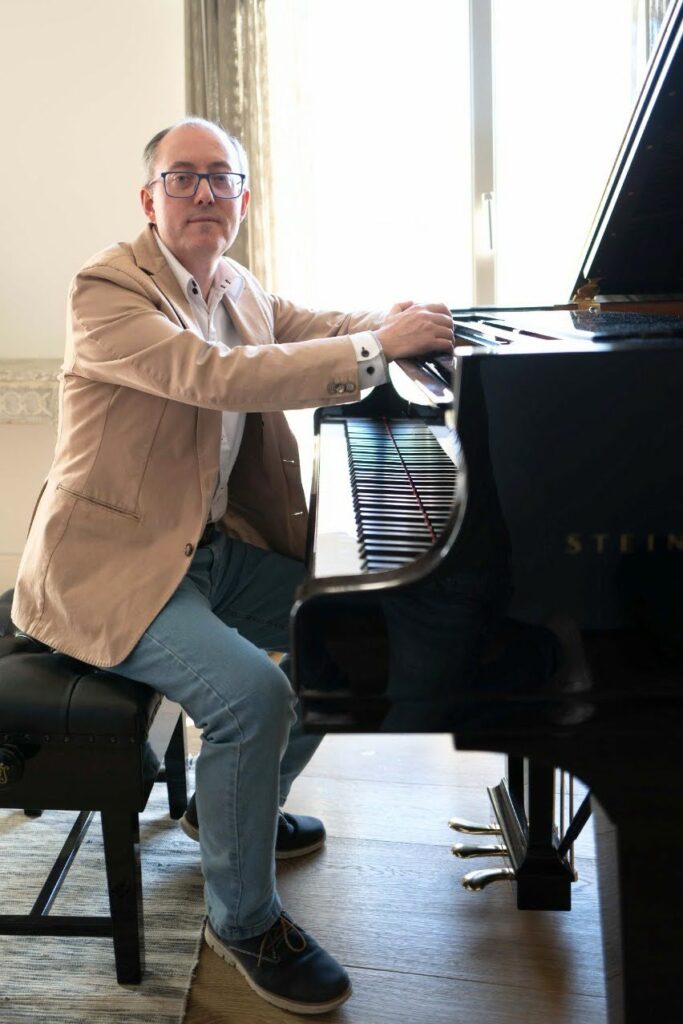



The program for the concert by Antonii Baryshevskyi (Ukraine) on 19.10.2025
.
Arvo Pärt (born 1935)
- "For Alina" (1976)
- "Variations on the recovery of Arinushka" (1977)
Valentyn Sylvestrov (born 1938)
- Two pieces from the cycle Kinderalbum No. 1
(1977)
- The Messenger (1996)
Borys Lyatoshynskyi (1895-1968)
- from Spiegelungen, op. 16 (1925):
I. Maestoso e con fermezza
II. Vellutato assai
III Tempestoso
V. Come di lontananza
Maurice Ravel (1875-1937)
Miroirs (1905):
I. Noctuelles ("moths")
II Oiseaux tristes ("Sad Birds")
III. Une barque sur l'océan ("A boat on the ocean")
IV. Alborada del gracioso ("Morning serenade of the
jester")
V. La vallée des cloches ("The valley of the bells")
.
Reflections
Music has always reflected the time in which it
is composed.
Against the backdrop of the turbulent 20th century -
characterized by new cultural trends, experiments
and demands - it unfolds in a particularly complex way in the European
musical landscape.
The "Reflections" program brings together music by four
composers that reflect the multifaceted sensibilities of the 20th century.
The subtlety of a woman of the twentieth century
The impressionistic language of Maurice Ravel is transformed
into the sharply dissonant aphorisms of Borys
Ljatoschynskyi, while the bright delicacy of Arvo Pärt's Tintinnabuli style corresponds with the metaphorical transparency of Valentyn Sylvestrov's
musical universe
.
Arvo Pärt (1935*)
In the 1970s, Estonian composer Arvo
Pärt withdrew from the flood of information and everyday noise
and created his own musical space of
"sounding silence". He developed the
technique he discovered, "Tintinnabuli" (Latin tintinnabulum - "little bell"),
in which two voices interact with each other: one
melodic, which moves diatonically, and one
"bell-like", which arpeggiates the tonic. This
creates an atmosphere of inner brightness and spiritual
harmony.
.
"Für Alina" (1976) is the first work using the tintinnabuli technique. The shortest tone sequences, minimal texture and
slow tempo create a space of quiet contemplation.
The music seems to stop time and opens up a place
of inner peace. The piece is dedicated to the daughter of
friends who went to England after her parents' divorce
- it sounds like a blessing for a new
life.
A year later, Pärt composed the "Variations on the
Recovery of Arinushka" (1977), a
cycle of variations dedicated to his own daughter Arina
. The graphic clarity and the
characteristic "little bells" structure gain particular expressive power here
: the repeated variations
have the effect of a heartfelt, pleading prayer - a resounding
healing gesture.
Valentyn Sylvestrov (1937*)
With the cycle "Kindermusik" (1977),
Sylvestrov opens up a chamber-musical, poetic world of
simple intonation and fine lyricism. In these
piano miniatures, he takes us back to the origins of
music - to a childlike perception of
sound as a miracle.
"The Messenger" (1996), composed in memory of his wife
Larissa, is to be understood as a dialog between the earthly and
the eternal. Sylvestrov described the work as a
"postscript to Mozart and the entire
classical tradition": Mozartian reminiscences gradually transform
into an enraptured, ethereal world of sound. The
composer creates the image of a "messenger" between the
worlds - a delicate sound substance that carries loving
memories and the trace of the past.
.
Borys Ljatoschynskyi (1895-1968)
On the 100th anniversary of the cycle. The cycle
"Vidobrazhennja" ("Reflections")
is one of the boldest examples of the early Ukrainian
avant-garde, in which a new artistic world of the
young Lyatoshynskyi is formed. The composer penetrates deep
into the human psyche: mental states, inner
contradictions, reflections and emotional impulses
become the material of his music.
The work, composed in 1925, opens a new chapter in
Ukrainian music. Inspired by the European
currents of the early 20th century,
Lyatoshynskyi moves in the field of tension between tonality and
atonality: the harmony dissolves the tonal center,
rhythmic structures appear as sudden
bursts of energy, the traditional meter breaks down and
the piano texture gains orchestral plasticity.
He creates his own musical language - intellectually
and emotionally heightened. His expressive view of the world is reflected
in the sensitive mirror of the inner "I". Here he forms
The Lyatoshynskyi whom we later hear in his symphonies
and chamber works: a thinker, humanist and
tragedian of his time, who experienced the 20th century with all its
expressiveness, pain and insight
.
After a hundred years, the "Spiegelungen" sound like a
living document of their era - a sound mirror in
which we recognize ourselves
in the light of today's wartime reality.
.
Maurice Ravel (1875-1937)
The five-part piano cycle "Miroirs" (1905) is one of
the key works of French Impressionism.
With a palette of complex, dazzling harmonies,

Ravel creates tonal "paintings" that evoke almost
visual associations - the play of light and
shadow, the shimmering of water or the resonance of
distant bells. His "painterly" metamorphosis opened up
new expressive possibilities for music and paved the way
for bold sound experiments.
1.Noctuelles ("moths")
Shimmering up and down movements - like the circling of a
moth around the light. Transparent textures,
changing harmonic colors and a floating
flow of movement characterize the piece.
2.Oiseaux tristes ("Sad Birds")
A dark, melancholy character in which melodic
lines echo in space like bird calls. Bright, sparkling
timbres lend the piece delicate transparency and
the impression of trembling loneliness.
3.Une barque sur l'océan ("A boat on the
ocean")
A musical seascape of boundless expanse: the
glittering and rocking of the water, depicted in undulating
arpeggios and colorful harmonies.
4Alborada del gracioso ("Morning
Serenade of the Jester")
Virtuosic and sparkling, filled with Spanish
temperament. Contrasts of rhythms and timbres,
.
sharp syncopations and brilliant passages create a
lively picture of wit and subtle irony.
5.La vallée des cloches ("The Valley of the Bells")
A calm, majestic soundscape in which the echo
of the bells gradually drifts away in space. Ravel masterfully uses
the possibilities of the piano to evoke the
floating magic of bell sounds.
Short biography
of Antonii Baryshevskyi
Antonii Baryshevskyi was born in Kiev in 1988. He
studied at the National Academy of Music in Kiev and
Paris.
He has won prizes at the following piano competitions, among others:
Arthur Rubinstein 2014 (1st prize); 58th Ferruccio Busoni
International piano Competition 2011 (2nd prize and
Audience Prize); 51st International Piano Competition
Premio Jaèn 2009 (1st prize); 2nd International Competition Premio Jaèn 2009 (2nd prize). International Competition
of the International Academy of Music (1st prize).
Baryshevskyi has performed in numerous European countries, the
USA and Israel and has appeared with well-known
orchestras in concerts and at festivals in the
most famous concert halls in the world.
Website: https://www.antoniibaryshevskyi.com/
https://www.youtube.com/channel/UCh1AIunLT3wUfaqSB
AkcLYA

                               Tatjana Shylina-Lenk