

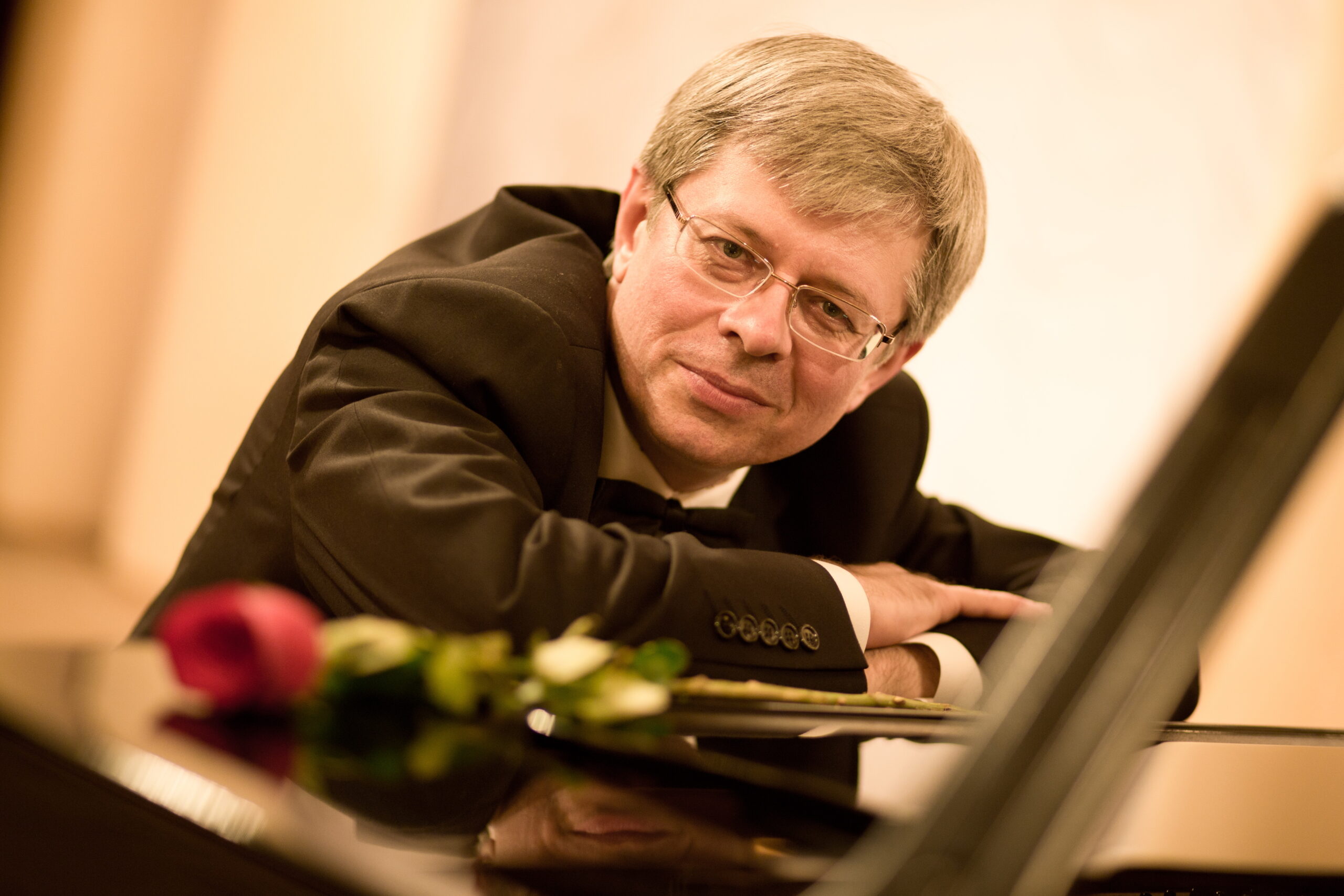
The program for the concert by Yurii Kot (Ukraine) on 22.02.2026
Ludwig van Beethoven (1870-1827)
Piano Sonata No.8, op.13 "Pathetique" (1798)
Piano Sonata No.14, op.27 No.2
"Moonlight Sonata" (1801)
Vasyl Barvinsky (1888-1963)
Piano Sonata in D flat major (1910)
.
Known and Unknown - Correcting the History of Music

 For over two centuries, Ludwig van Beethoven's piano sonatas
have been regarded as a shining example of the
tradition of classical European piano music.
The sonata by the Ukrainian composer Vasyl
Barvinsky, composed in 1910, could have been performed on the world's great stages for more than
hundred years
if its fate had not taken a tragic turn
.
By order of the Soviet authorities,
this work was burned together with other manuscripts in the
courtyard of the Lviv Conservatory in 1948
. Barvinsky himself was deported to the
mordwinian labor camps for ten years. After his return to
, Barvinsky tried to reconstruct his compositions from memory until the end of his life
at
.
Vasyl
Barvinsky's music was forgotten for almost half a century and it is only since the independence of
Ukraine that it has gradually begun to return to concert life
.
As the Soviet government deliberately destroyed Ukrainian culture
, Barvinky's work is still largely unknown outside of
Ukraine.
The Berlin premiere of the piano sonata by the Ukrainian
composers alongside the world-famous sonatas of
Beethoven is therefore an event of particular
significance - an act of rectification of a destroyed
history of Ukrainian music in the pan-European
artistic context.
.
Ludwig van Beethoven (1770-1827)
Piano Sonata No. 8 in C minor op. 13 "Pathétique"
(1798)
At the end of the 18th century, Vienna was the
musical capital of Europe, a center of intense
artistic movement. The young Ludwig
van Beethoven came here in 1792 and quickly joined the
traditions of the Viennese masters. His
name soon joined those of Joseph Haydn and Wolfgang
Amadeus Mozart to become an integral part of the
musical history that has been referred to for more than two centuries as
"Viennese Classicism".
The "Pathétique" Sonata was composed when Beethoven was 28
years old and is dedicated to Count and patron Karl von
Lichnowsky. Beethoven expanded the
possibilities of the piano by filling the texture with an
"orchestral" sound: The "symphonization" of the
piano language as well as the merging of the individual
movements into a cohesive artistic whole
elevated the genre of the sonata to a new level.
The three movements are carried by a unified
dramaturgical idea - the path "from
darkness to light". Music critics regarded this
sonata as an artistic image of a dialog between two forces:
inexorable fate and the human
striving to overcome it. This image appears again later
in the "Eroica", the Third Symphony, and finally
in the Fifth Symphony, which is also in the same key of C minor.
.
Piano Sonata No. 14 in C sharp minor op. 27 No. 2
"Moonlight Sonata" (1801)
The music writer Ludwig Rellstab compared the
music of the first movement to the moonlight reflected on the
surface of Lake Lucerne - from this
the name "Moonlight Sonata" was later derived. The work
is dedicated to Countess Giulietta Guicciardi, a Viennese
aristocrat and piano pupil of Beethoven. The
composer himself described the sonata as a "sonata quasi
una fantasia" By moving away from the canonical
structures of the classical sonata form,
Beethoven combined contrasting characters into a
cohesive dramaturgical unit:
from the contemplative, poetic mood of the first
movement through the light, dance-like scherzo, -which Franz
Liszt compared to a "flower between two abysses"
- to the powerful, emotionally charged finale
as the culmination. For more than two hundred years
this work has occupied a special place in the
international concert repertoire.
Vasyl Barvinsky (1888-1963)
Piano Sonata in D flat major (1910)
Vasyl Barvinsky is one of the central and at the same time
tragic figures of Ukrainian musical culture
in the first half of the 20th century - a composer
of European standing. His artistic path formed
in the space of Central European culture between
Lviv, Prague and Vienna and was forcibly interrupted by the
Stalinist terror.
Barvinsky received his professional training in
Lviv and at the Prague Conservatory, where he developed in the
environment of modern European art of the early 20th
century.
As a pianist and composer, he
already showed a keen interest in new compositional techniques and forms during these years.           After
his return to Lviv, Barvinsky became a
central figure in the city's musical life: for over
24 years he directed the Mykola Lysenko Music Institute and
later the Lviv Conservatory, combining his
compositional with pedagogical, organizational and
educational activities.
After returning to Lviv
in 1958, almost deaf after ten years in the
Mordovian camps, he was forbidden to teach at
or even enter the building of the
Conservatory. He bitterly summarized his life
with the words "I am a composer without
scores."
Nevertheless, Vasyl Barvinsky was the first Ukrainian
composer whose works were published on various continents
- in Europe, the United States
and Japan (Edition Peters, Universal Edition, Nakamura to
1939).
The
Sonata in D flat major (1910) - the first Ukrainian
piano sonata of the 20th century - occupies a special place in his oeuvre. Large-scale in form
and virtuosity, it combines the classical sonata structure
with features of modern musical thinking. In the
first movement, the rhythmic-intonatoric and
pentatonic core of the Siciliana is developed in a strictly
monothematic manner, while the finale culminates in
a complex double fugue.
Today, Vasyl Barvinsky's legacy is gradually returning to
Ukrainian and international stages. His work
appears as an example of a highly developed European
culture that should be destroyed, but which cannot be erased from the
history of music.

                                      Tatjana Shylina-Lenk