

The program for the concert by Borys Fedorov (Ukraine) on 28.03.2026
Mykola Lysenko (1842-1912)
"Album of the summer of 1900"
- "Confession of love"
- "Song of love"
- "Serenade" (op. 37)
Robert Schumann (1811-1856)
Papillons, op. 2 (цикл для фортепіано)
Valentyn Sylvestrov (*1937)
Sonata No. 2 (1975)
Claude Debussy (1862-1918)
Trois Préludes (1909):
- "Les sons et les parfums tournent dans l'air
du soir"
- "Les collines d'Anacapri"
- "Des pas sur la neige"
L'isle joyeuse (1904)
.
Islands of music
The trends in music in the 19th - 21st centuries
move between three islands - Romanticism,
Modernism and the avant-garde.
Romanticism forms the breeding ground for modernism, while the
avant-garde breaks with all traditions
and creates new soundscapes.
We have combined the music of these three artistic styles - the
metaphorical "islands" - into a "sound archipelago" in our program
.
Romantic poetry is reflected in the
fantastic "Papillons" (butterflies) by Robert
Schumann, as well as in the Ukrainian lyrical world of Mykola Lysenko's "
Album of Summer (1900).
Claude Debussy blurs the rhythmic and harmonic boundaries of
Romantic sound painting with an impressionistic
brush.
In 1904, his
"L'isle joyeuse (The Island of Joy)" rose on the musical horizon like a
sun-drenched fountain. In 1909, the
refined images of the French master's Préludes float:
They circle as "sounds and scents in the evening sky", rise
on a colorful Neapolitan wave to the
"hills of Anacapri" and finally merge
with the cautious "footsteps in the snow".
At the end of the 1960s, the Ukrainian
composer Valentyn Sylvestrov - restricted by
Soviet censorship - broke through the floodgates of
"parade Soviet splendor" together with like-minded
Kyiv composers and paved a tunnel to
European freedom. He became one of the architects
of an independent "musical island" known today as the
"Kyiv avant-garde".
.
Mykola Lysenko (1842-1912)
"Album of the Summer of 1900"
"Confession of Love", "Song of Love", "Serenade", op. 37
As recalled by a traveler who came to Kyiv at the beginning of the 20th
century: Music could be heard from almost every window
of Khreshchatyk Street. Domestic
music-making was extremely widespread at the time, and the
salon and chamber genre formed an important
part of cultural life. Mykola
Lysenko created his cycle "Album of Summer 1900", which became
a kind of lyrical diary of the composer, precisely in the
aesthetics of the romantic salon miniature. The
elegant atmosphere of salon romanticism is combined here
with echoes of the German romantic tradition.
A short quotation from the "Album for Youth" by
Robert Schumann appears in the second piece of the cycle,
"Song of Love", like symbolic memories of
Lysenko's student years and dissolves into the warm lyrical
tone of the Ukrainian melody. As is well known,
Mykola Lysenko began his professional musical
training at the Leipzig Conservatory. One of his
teachers was Ernst Ferdinand Wenzel, a representative of the
German Romantic school, the brilliant pianist and
friend of Robert Schumann and Johannes Brahms. Thus
the wonderful musical rhymes of
German and Ukrainian Romanticism weave themselves into the subtle
poetry of the lyrical "Album of Summer 1900".
Robert Schumann (1811-1856)
Papillons, op. 2
The idea of the piano cycle "Papillons" (1829-1831) goes
.
to the novel "Flegeljahre" by Jean Paul -
in particular to the scene of a carnival masked ball, the
so-called "masked dance".
The twelve miniatures appear to the listener like
fleeting episodes of a carnival ball. The
butterflies are a metaphorical image for
changing impressions that pass by in a whirl of dance. The
cycle resembles a poetic kaleidoscope of
moods and characters - and already reveals the
Romantic world of fantasy and symbolic images
that would later unfold in Schumann's great
piano cycles.
Valentyn Sylvestrov (*1937)
Sonata No. 2 (1975)
"Something
strange appeared in the music of the 20th century - the fear of silence. But as
turns out, silence can be the most precious thing in the
world.            The biggest idea is a quiet, peaceful life.
This is a really big idea - not those 'big ideas',
for which millions of lives are destroyed."
(from an interview with the composer, 2024)
In the 1960s, Valentyn Sylvestrov founded
together with young Ukrainian composers -
including Leonid Hrabovsky, Vitalii Hodzyatskyi, Volodymyr
Zahortsev and Volodymyr Huba - the group "Kyiv
Avant-garde", which was united by the outstanding Ukrainian
conductor Ihor Blazhkov. Despite bans and
Soviet censorship, these artists opened a new
page in the history of Ukrainian music by orienting themselves
towards innovative compositional techniques
. Later, however, Sylvestrov moved away from the
.
avant-garde and found a new musical language, which he called
"metamusic". The composer said:
"The avant-garde is like eating only salt -
and too much of it. Without salt, everything would be bland, but it is
It is present in these texts."
Claude Debussy (1862-1918)
Three Preludes (1909), "L'isle joyeuse" (1904)
"Sounds and scents floating in the evening sky"
The title of this prelude comes from a line of the
poem "Harmonie du soir" by Charles Baudelaire from
of the collection Les Fleurs du mal.
The melody of an almost improvisational waltz
seems to float above spicy harmonies and creates
the feeling of a slow movement of the air - a
circle of scents and sounds in the evening twilight.
"The Hills of Anacapri"
The images in this prelude are linked to
the town of Anacapri on the Italian island of Capri.
Debussy paints a colorful atmosphere of the
southern landscape: sun, sea breeze, bells,
folk dances and songs.
The dancing rhythm of the tarantella and
bright chordal figures create the atmosphere of a
folk festival.
"Footsteps in the Snow"
One of the most restrained and melancholy
preludes in the cycle. Debussy paints a
winter landscape in which an ostinato rhythmic bass is reminiscent of
slow footsteps in the snow. A melody full of
loneliness and quiet contemplation unfolds over this
recurring pulse.
.
"L'isle joyeuse" (1903-1904)
The impetus for this work came from the
painting "Embarkation to Kythera" by Jean-
Antoine Watteau - the island that in Greek
mythology is considered the birthplace of Aphrodite, the goddess of love.
The work is also associated with Debussy's personal life in
: he completed it during a
stay on the island of Jersey together with his
lover Emma Bardac.
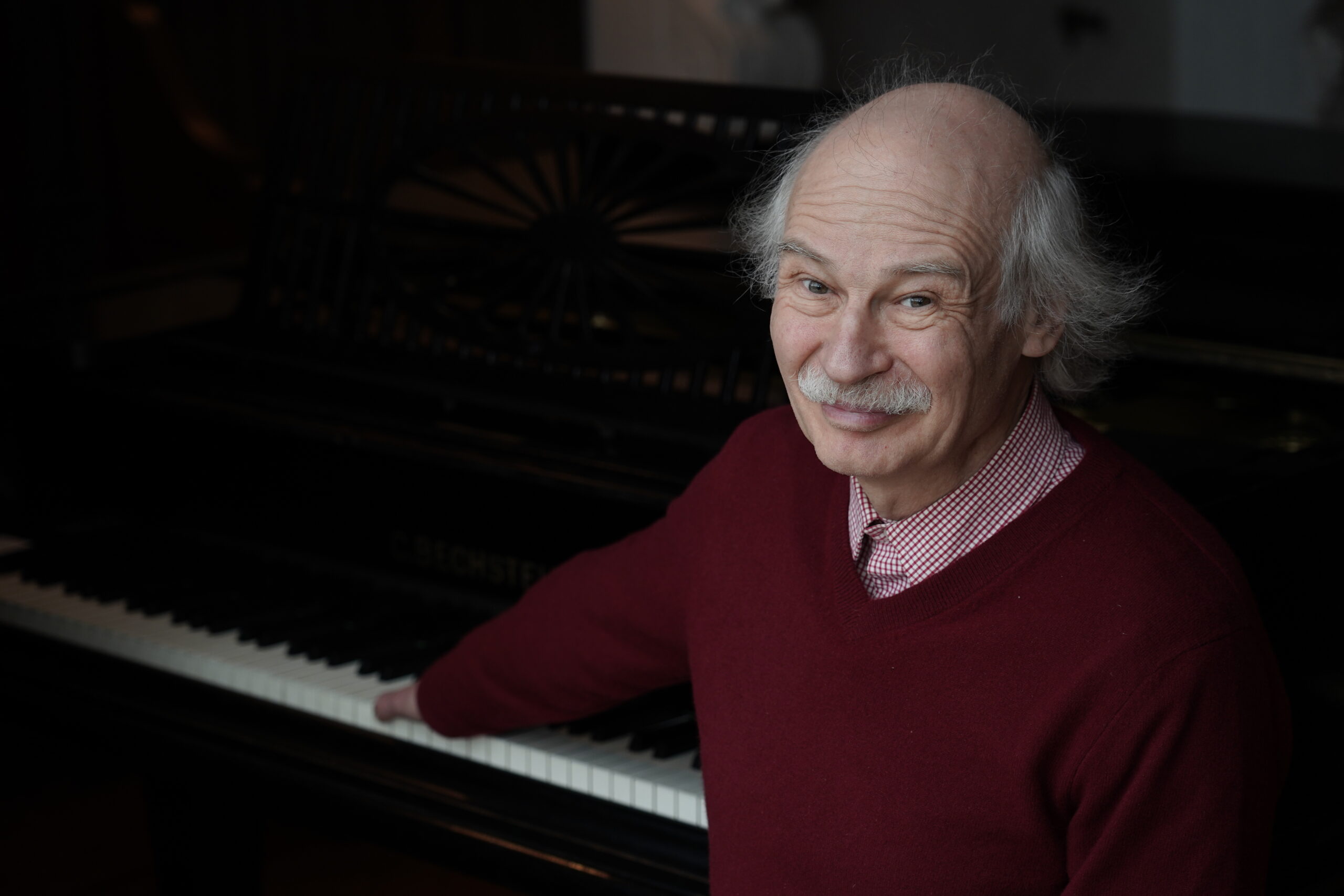
Borys Fedorov is a Merited Artist of Ukraine,
concert pianist, winner of numerous international
competitions and one of the leading music teachers in his
country. His repertoire includes music of various styles and
eras. His awards include the special prize for
the interpretation of contemporary music in Porto (1993), the A.
Roussel Prize in Senigallia (1994), second prize at the
competition in Rome (1995) and the Grand Prix of the festival
Regina and Vladimir Horowitz In Memoriam in Kyiv (1995).
He has performed with leading orchestras and recorded
several times for the National Radio and Television Company of
Ukraine. In recent years he has also given concerts in the
piano duo with his daughter, the pianist Anna Fedorova, in the
Great Hall (Grote Zaal) of the Concertgebouw in Amsterdam.
He has also given solo concerts and masterclasses in China,
Greece and the Netherlands.
Since 2020 Borys Fedorov has also devoted himself intensively to
composition. His works have been performed on Dutch
national radio, at the Stift International Music Festival and at
a concert for the 30th anniversary of the Channel
Classics label, and have received great acclaim from
leading musicians and composers.

                                            Tatjana Shylina-Lenk